To Change the World
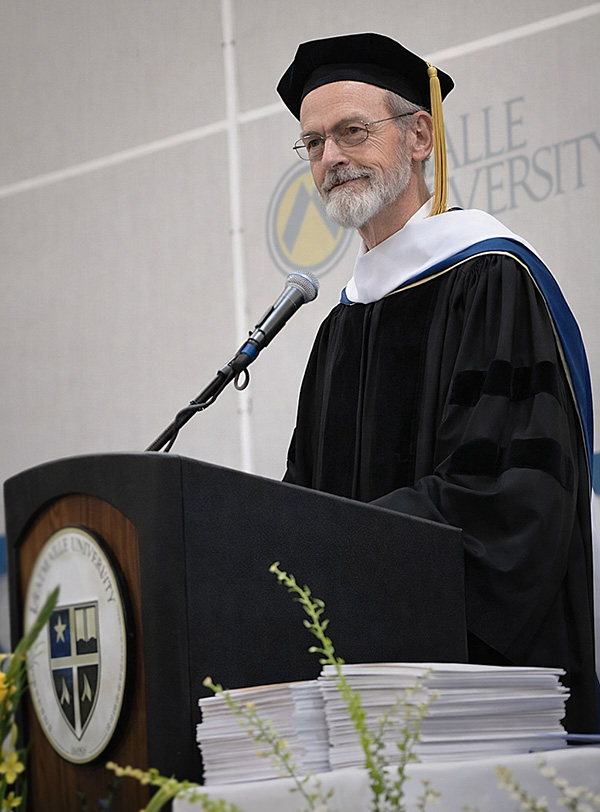
La Salle University Honorary Degree Speech
October 5, 2008
“Never doubt that a small group of thoughtful, committed people can change the world. Indeed, it’s the only thing that ever has.”
These words by Margaret Mead tell the story of the people of Highbridge, speak of the founding mission of La Salle University, and offer a significant challenge to each of us.
Hundreds of people associated with the Highbridge Community Life Center in the South Bronx neighborhood of the same name have been working together for 25 years to change their lives and their community. Some come from faraway places with skills in teaching, social work, and community organizing that they are willing to share in classes and workshops. Others come as Lasallian Volunteers from colleges and universities like this one to live in community with the Christian Brothers, share their mission, and help the people of the South Bronx.
But by far, the lion’s share of these hundreds are families who call Highbridge home. Often, these men and women—who have suffered horrific events in their native countries—have come here as immigrants to find a better life. Often, they are parents with a long history of unemployment or underemployment, little or no success in school, and a low sense of personal achievement, yet they hold a strong conviction in the value of education for themselves and their children, as well as the need for meaningful employment.
Magic happens on the level of Margaret Mead when these three groups—professionals, volunteers, and community residents—realize they need each other and begin to collaborate on change. Unusual cross-cultural relationships form between teachers and adult students around a shared ownership of programs in adult basic education, family counseling, job training, and community organizing. Results follow. Adults become literate, earn GEDs, find jobs, and their children stay in school. The whole community begins to look better and feel safer. Results: fewer children are taken away from their families due to neglect or abuse. Results: the City of New York takes seriously requests for school improvements and community infrastructure. Results: residents become staff members and begin working with their neighbors at a new level.
In short, when staff, volunteers, and community residents recognize their individual limitations and vulnerabilities and begin collaborating, they can break the cycle of poverty, build personal and community assets, and bridge to a better life.
And remember, all of this is happening in a neighborhood that is part of the country’s poorest congressional district. It is also the one that inspired Howard Cosell to coin the phrase “the Bronx is burning” during the 1977 World Series at Yankee Stadium.
We each have an enormous capacity to change our world.
As CEO of this community effort for over 20 years, I have learned that leadership is as important as management.
I have learned that community residents should be involved in all planning, should serve as board members, and should help evaluate all programs. No salary should exceed three times the lowest salary. Creativity, risk, flexibility, and “going with the flow” are keys to success. Results and outcomes are essential to being a high-performing organization and to earning investments from foundations, states, and individual donors. And, in the words of this university, “never stop exploring.”
It is clear to someone in my position that your university has long pursued the development of thoughtful, committed people who will change the world.
Service learning, service trips, community service scholars, and the nonprofit center’s work with community-based organizations all come to mind. This university is putting its institutional resources—staff and students—at the disposal of the greater community. Students learn and serve at the same time.
Wonderful.
This is not surprising, because the namesake of this university, and my model in Highbridge, is John Baptist de La Salle. In the 17th century, he was drawn into the world of the poor—of disadvantaged students and their parents, who were chronically oppressed by poverty.
He brought together a group of men to address the lack of schools. He never stopped exploring innovative solutions to the problems of his time. Years later, his band became known as the “Brothers.” Schools everywhere were named after him, and the successors to this small band today are the De La Salle Christian Brothers, along with their associates, collaborators, and volunteers.
Finally, I would like to remind all of you that there are hundreds of community-based organizations in every major city, and they all need help. These organizations have a particular need for leadership today. An unusually high percentage of their executive leadership is retiring, and transitions are common. It is difficult to maintain high-quality services while attracting new leaders. A wide variety of organizations and their leaders will be on campus this coming week—check them out and consider getting involved.
Most of all:
“Never stop exploring,” and “Never doubt that a small group of thoughtful, committed people can change the world. For indeed, it is the only thing that ever has.”
Bro. Michael McGinniss, I am most honored to receive this degree today.
Dr. Bonnie Zetick, thank you for sponsoring me.
Thank you all.
Ed Phelan